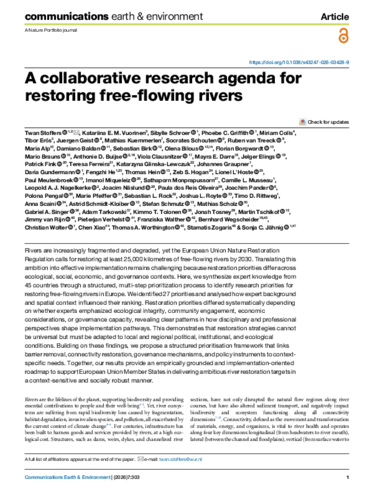
Rivers are increasingly fragmented and degraded, yet the European Union Nature Restoration Regulation calls for restoring at least 25,000 kilometres of free-flowing rivers by 2030. Translating this ambition into effective implementation remains challenging because restoration priorities differ across ecological, social, economic, and governance contexts. Here, we synthesize expert knowledge from 45 countries through a structured, multi-step prioritization process to identify research priorities for restoring free-flowing rivers in Europe. We identified 27 priorities and analysed how expert background and spatial context influenced their ranking. Restoration priorities differed systematically depending on whether experts emphasized ecological integrity, community engagement, economic considerations, or governance capacity, revealing clear patterns in how disciplinary and professional perspectives shape implementation pathways. This demonstrates that restoration strategies cannot be universal but must be adapted to local and regional political, institutional, and ecological conditions. Building on these findings, we propose a structured prioritisation framework that links barrier removal, connectivity restoration, governance mechanisms, and policy instruments to context-specific needs. Together, our results provide an empirically grounded and implementation-oriented roadmap to support European Union Member States in delivering ambitious river restoration targets in a context-sensitive and socially robust manner.
A collaborative research agenda for restoring free-flowing rivers
Peer-reviewed
Stoffers, T., Vuorinen, K. E. M., Schroer, S., Griffith, P. C., Colls, M., Erős, T., Geist, J., Kuemmerlen, M., Schouten, S., van Treeck, R., Alp, M., Baldan, D., Birk, S., Bilous, O., Borgwardt, F., Brauns, M., Buijse, A. D., Clausnitzer, V., Darre, M. E., … Jähnig, S. C. (2026). A collaborative research agenda for restoring free-flowing rivers. Communications Earth & Environment, 7(1), 303. https://doi.org/10.1038/s43247-026-03428-9
Published
: 2026
Appeared in
: Communications Earth & Environment