
Despite more than 50 years of research into the human dimensions of recreational fisheries, there is no textbook to present the theoretical grounding, operationalisation, and interpretation of the most elemental social components involved in fisheries management – namely, outcomes and trade-offs, behaviours (and antecedents or predictors of it), and the relationships among actors (fishers, fisher groups, managers, and management organisations). The objective of this edited volume is to reduce this knowledge gap. The book comprises four parts: (I) recreational fisheries as social-ecological systems, (II) disciplinary views of fishers’ behaviours and outcomes, (III) engagement of fishers to support effective social science, and (IV) interdisciplinary integration for recreational fisheries management. Part I provides the general motivation for an interdisciplinary approach to understand recreational fisheries as coupled systems. Part II provides the foundations of various social science disciplines and highlights linkages and differences in the underlying theories and concepts used. Part III describes various qualitative and quantitative methods to study the social aspects of recreational fisheries in more detail, and Part IV suggests approaches to achieve standardisation and integration of different data streams, including how to link social and ecological data. The book chapters have been written by leading scholars of recreational fisheries science, involving social and economic scientists, political ecologists, and fisheries ecologists with a tradition in either applying human dimensions or working towards integration.
Understanding Recreational Fishers
Book
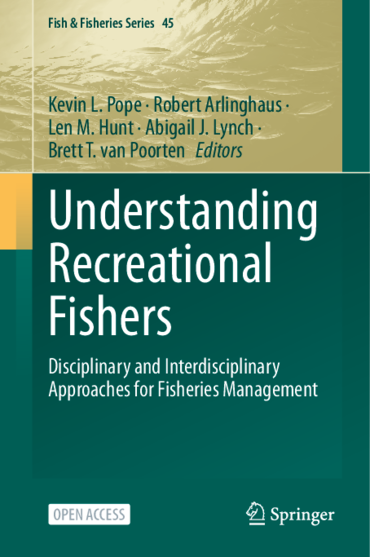
Pope, K. L., Arlinghaus, R., Hunt, L. M., Lynch, A. J., & van Poorten, B. T. (Eds.). (2026). Understanding recreational fishers: Disciplinary and interdisciplinary approaches for fisheries management. Springer Cham. https://doi.org/10.1007/978-3-031-99739-6
Published
: 2026
Appeared in
: Springer